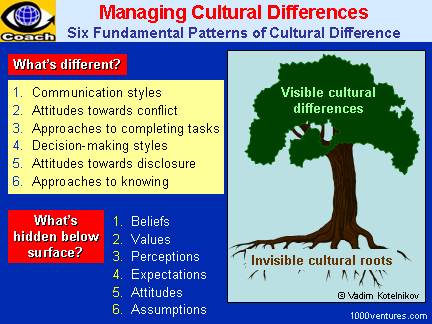
Culture is the "lens" through which you view the world. It is central to
what you see, how you make sense of what you see, and how you express
yourself...
More
Respecting Differences and Working
Together
Anthropologists discovered that, when faced by
interaction that we do not understand, people tend to interpret the others
involved as "abnormal", "weird" or "wrong"1. Awareness of
cultural differences and recognizing where cultural differences are at work
is the first step toward understanding each other and establishing a
positive working environment.
Use these differences to challenge your own
assumptions about the "right" way of doing things and as a chance to learn
new ways to solve problems.
Cross-Cultural
Communication Challenges
Culture is often at the root of communication challenges. Exploring historical experiences and the ways in which various
cultural groups have related to each other is key to opening channels for
cross-cultural communication. Becoming more aware of
cultural differences,
as well as exploring cultural similarities, can help you communicate with
others more effectively. Next time you find yourself in a confusing
situation, ask yourself how culture may be shaping your own reactions, and
try to see the world from the other's point of view...
More
Case in Point:
Eye Contact
In some cultures,
looking people in the eye is assumed to indicate honesty and
straightforwardness; in others it is seen as challenging and rude.
In USA, the cheapest, most effective way to
connect with people is to look them
into the eye.
"Most people in Arab cultures share a great deal of eye contact and may
regard too little as disrespectful. In English culture, a certain amount of
eye contact is required, but too much makes many people uncomfortable. In
South Asian and many other cultures direct eye contact is generally regarded
as aggressive and rude."2...
More
Harnessing the Power of
Diversity in Business
Diversity is
a specialized term describing a workplace that includes people from various
backgrounds and cultures, and/or diverse businesses.
You can find a strategic
competitive advantage in an organizational and cultural context by
seeking to leverage, rather than diminish, opposite forces. An important
but widely overlooked principle of business success is that integrating
opposites, as opposed to identifying them as inconsistencies and driving
them out, unleashes power. This is true on both a personal level (the
balanced manager is more effective than his or her peer at one end of
the control spectrum) and on
organizational level as well...
More
 Strategic
Alliance Targeting Muslim Clients
Strategic
Alliance Targeting Muslim Clients
Many persons misunderstand
Islam, including Muslims and Business. There are many things which seem
innocuous to non Muslims which are major issues in
Islam.
Myself and my Singapore-based Muslim partner
both do things differently... and this is the strength. Even the same things
we would do differently.
If I'm targeting Muslims my partner can
configure or advise on the best way to do that. Another way is if I am
teaching principles he can tell a Muslim audience how to apply it and still
be Muslims. When we present a course of
training
we combine my modules and deliver a SET but integrated solution that would
not be available to either of us, if we never had that collaboration... like
thesis and anti-thesis for synthesis.
Sexless
Cultures